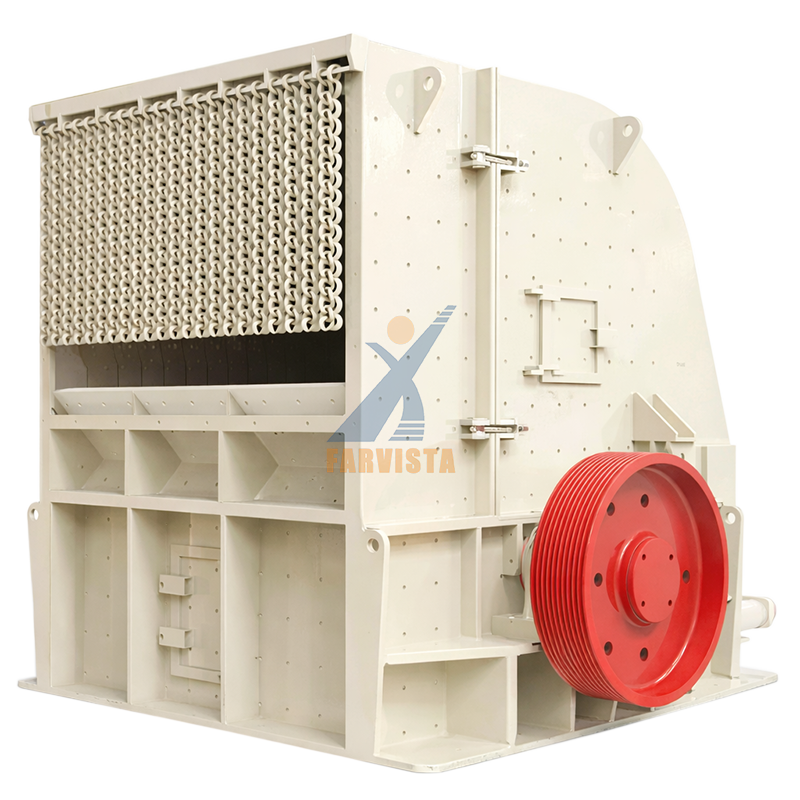
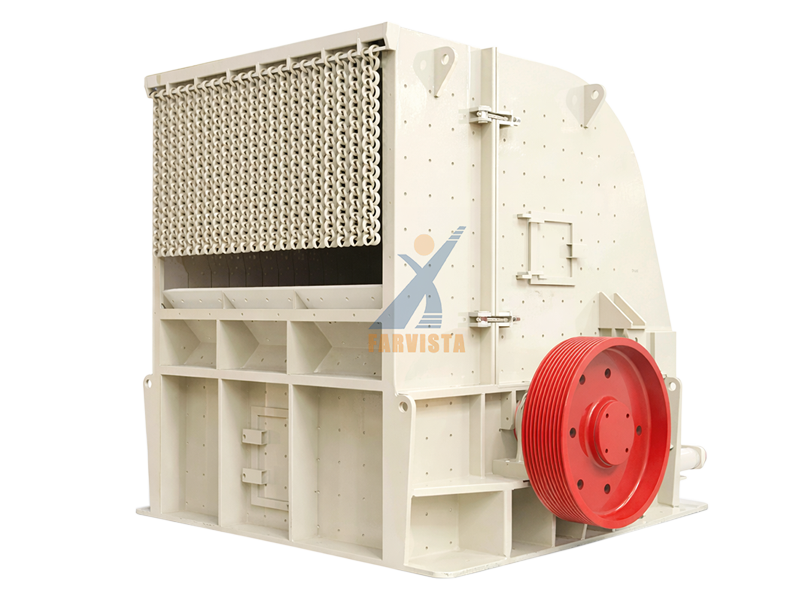
VPF Series Impact Crusher for High-Quality Aggregate Production
The VPF Series Impact Crusher delivers high reduction ratios, excellent cubic particle shape, and efficient energy utilization, making it ideal for medium and fine crushing of low-to-medium hardness materials in modern aggregate production lines.
VPF Series Impact Crusher – Reliable Solution for Shaping-Oriented Crushing
The VPF Series Impact Crusher is a highly efficient crushing machine designed for medium and fine crushing of low-to-medium hardness and brittle materials. Utilizing impact energy rather than compressive force, this crusher is particularly suited for applications where final product shape, gradation, and value-added aggregates are critical factors. It has become an essential piece of equipment in modern aggregate production lines, construction waste recycling systems, and selected mining and industrial applications.
Unlike traditional compression crushers, the VPF Impact Crusher operates on the principle of high-speed impact. Material entering the crushing chamber is struck by rapidly rotating blow bars mounted on the rotor. The material gains kinetic energy and is then thrown against the impact plates, where further breakage occurs through repeated collisions. This combination of “rock-on-iron” and “rock-on-rock” crushing ensures effective size reduction while producing aggregates with superior cubic shape and minimal flaky or elongated particles.
Structural Design and Main Components
Heavy-Duty Frame The main frame is divided into upper and lower sections and fabricated from high-strength steel plates through precision welding. The internal surfaces are lined with replaceable wear-resistant liners to protect the structure and extend service life under continuous operation.
Rotor Assembly – The Core of Performance The rotor is the heart of the impact crusher. It consists of a robust main shaft, rotor discs, and blow bars. Each rotor undergoes strict dynamic balancing to ensure stable operation at high rotational speeds. The rotor’s linear velocity typically reaches 30–50 m/s or higher, providing sufficient impact energy for efficient crushing.
Blow Bars (Hammers) Blow bars are key wear parts directly responsible for impacting material. Their geometry, material composition, and fastening method have a significant influence on crushing efficiency, wear life, and maintenance costs. Depending on application requirements, different materials such as high-chromium alloy or martensitic steel can be selected to balance wear resistance and toughness.
Impact Plates Installed above the rotor, impact plates form the crushing chamber together with the blow bars. Usually arranged in two or three stages, they allow material to undergo multiple impact cycles, ensuring controlled reduction and consistent product quality.
Adjustment System The gap between the rotor and the first and second impact plates can be adjusted to control the final product size. A smaller gap results in finer output, while a larger gap increases throughput. This adjustability allows flexible production to meet different gradation requirements.
Drive System The rotor is driven by an electric motor through V-belts, ensuring smooth torque transmission and stable high-speed operation while simplifying maintenance.
Application Areas
The VPF Series Impact Crusher is primarily used in medium and fine crushing stages where product shape is a key requirement.
Aggregate and Sand Production This is the most important application field. The VPF Impact Crusher is widely used to produce high-quality aggregates such as 12/13 mm stone, 5–10 mm stone, and manufactured sand. These products meet the strict shape and performance requirements of high-rise buildings, highways, bridges, and hydraulic engineering projects.
Construction Waste Recycling When processing construction and demolition waste, the impact crusher effectively breaks concrete blocks, bricks, and asphalt into reusable aggregates. The resulting materials have good shape and higher reuse value, supporting circular economy and sustainable construction practices.
Mining Industry Suitable for secondary and tertiary crushing of medium-hard minerals such as limestone, dolomite, gypsum, and coal. It is not recommended for highly abrasive or very hard materials such as granite or basalt, as wear part consumption would increase significantly and operating costs would rise.
Chemical and Metallurgical Industries Used for crushing coal, coke, and similar brittle materials where controlled particle size and shape are required.
Suitable Materials
Low-to-medium hardness and brittle materials, including:
Limestone
Weathered granite
Coal gangue
Concrete and demolition waste
Gypsum and similar minerals
Performance Advantages
Excellent Particle Shape Impact crushing causes material to break along natural fracture planes, producing mostly cubic particles with very low flaky content. This significantly improves concrete strength, durability, and workability.
High Reduction Ratio and Simplified Process With a reduction ratio that can exceed 50:1, a single impact crusher can often replace multiple crushing stages. This simplifies plant layout, reduces equipment investment, and lowers overall operating costs.
Efficient Energy Utilization A high proportion of input energy is directly used for effective breakage. For certain applications, energy consumption per ton can be lower than that of traditional compression crushers.
Flexible Adjustment and Multi-Purpose Use By adjusting rotor speed and impact plate clearance, operators can easily change product size distribution. This flexibility allows one machine to serve multiple production requirements.
Easy Maintenance and Reliable Operation Wear parts are designed for convenient replacement, minimizing downtime. The overall structure emphasizes durability, stability, and long service life under continuous industrial operation.