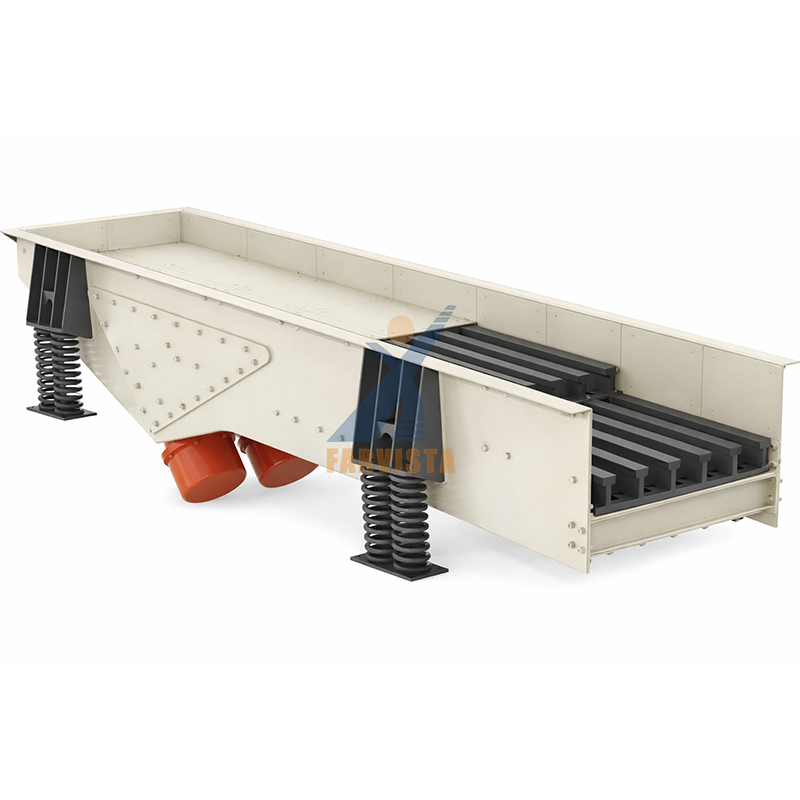
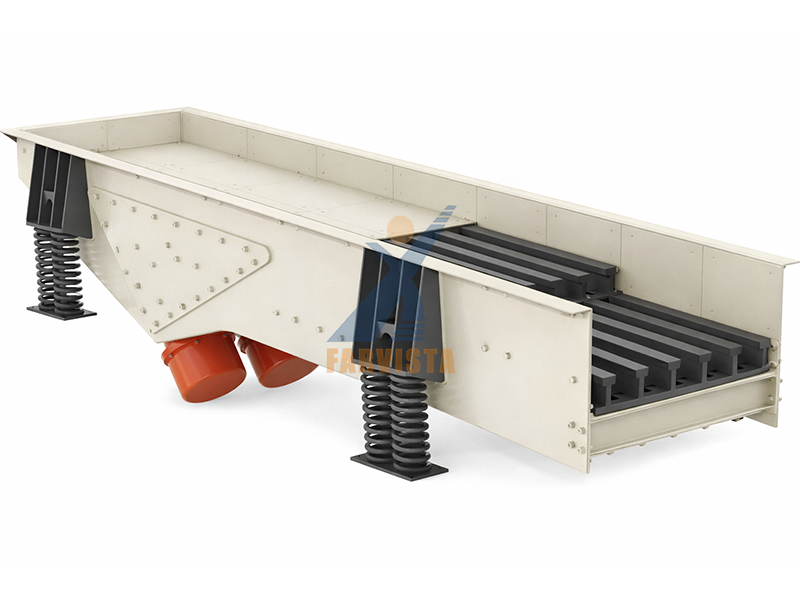
GZG Series Vibrating Feeder for Continuous and Uniform Material Feeding
Cost-effective vibrating feeder with simple structure, stable operation, low energy consumption, and uniform feeding performance. Widely used for continuous material feeding in various industries.
The GZG Series
Vibrating Feeder is one of the most widely used general-purpose and
cost-effective continuous feeding equipment in modern industrial production. It
is well known for its simple structure, reliable operation, low energy
consumption, low noise level, and stable, uniform feeding performance. This
series is typically equipped with two vibration motors as the excitation
source. Through their synchronous counter-rotating motion, a directional linear
vibration force is generated, driving the trough to convey materials forward in
a continuous and controlled manner.
As the “throat”
equipment in crushing, screening, and batching processes, the GZG Series
Vibrating Feeder plays an indispensable role in material conveying and
quantitative feeding across a wide range of industries. Its excellent
cost-performance ratio and operational stability make it a preferred choice for
many industrial applications.
Main Structure and Components
Feeding Trough
The feeding trough
is the component that directly carries and conveys materials. It is
manufactured from bent or welded steel plates and can be designed as an
open-type or enclosed-type structure according to application requirements.
Wear-resistant liners can be installed inside the trough when handling abrasive
materials, extending service life and reducing maintenance costs.
Vibration Motors
Vibration motors are
the core power source of the equipment. The feeder is usually equipped with two
identical vibration motors installed symmetrically on the trough. Their
synchronized counter-rotating motion generates a stable linear excitation
force, ensuring smooth and uniform material movement.
Vibration Isolation and Supporting System
The feeder is
supported by rubber springs or composite springs connecting the trough to the
foundation. These components perform several key functions:
Supporting the
combined weight of the trough and materials
Isolating vibration
to prevent transmission to the foundation
Allowing the trough
to perform the required directional vibration
Suspended or Base-Mounted Structure
Depending on site
layout and process requirements, the GZG Series can be designed for suspended
installation or base-mounted installation, offering high flexibility for
different production lines.
Application Industries
Thanks to its broad
adaptability, the GZG Series Vibrating Feeder is used in almost all industries
requiring continuous or quantitative material feeding.
Mining Industry
Installed below
storage bins in crushing and screening lines to provide uniform feeding to jaw
crushers, cone crushers, and other primary or secondary crushing equipment.
Coal Industry
Used for feeding and
conveying raw coal or washed coal in coal preparation plants and power
generation facilities.
Building Materials and Metallurgy
Provides
quantitative feeding for ball mills, dryers, and other processing equipment.
Commonly used as a front-end feeding unit in batching and proportioning
systems.
Chemical and Grain Industries
Suitable for
conveying various granular and powdered materials such as chemical raw
materials, fertilizers, and grains.
Light Industry and Electronics
Applied in automated
production lines for conveying small components and lightweight materials with
high consistency and controllability.
Applicable Materials
Suitable for
non-sticky, non-extremely high-temperature block, granular, and powder
materials. For special working conditions such as high temperature,
explosion-proof, or corrosion resistance, customized designs for motors and
trough structures can be provided.
Performance Advantages and Features
Simple Structure and Easy Maintenance
With a minimal
number of components and vibration motors as the core driving elements, daily
maintenance mainly involves lubrication and inspection of the motors.
Maintenance costs are extremely low.
Reliable Operation and Long Service Life
Unlike rotary
mechanical feeders with complex transmission systems such as gears and shafts,
the GZG Series has fewer failure points, ensuring reliable operation and
extended service life.
Low Energy Consumption and High Efficiency
Driven directly by
vibration motors, the feeder achieves high energy conversion efficiency. Power
consumption is primarily limited to material conveying, resulting in
significant energy savings compared to traditional apron feeders.
Uniform Feeding and Easy Adjustment
Material flow
remains stable and smooth, effectively preventing blockage or material buildup.
Feeding capacity can be continuously and smoothly adjusted by changing
vibration force through frequency or amplitude control.
Low Noise and Environmentally Friendly
Operating noise is
significantly lower than that of impact-type or chain-driven feeders. Enclosed
trough designs can effectively control dust emission and meet environmental
protection requirements.
Fast Start and Stop Response
The feeder starts
feeding immediately after power is supplied and stops material flow quickly
once power is cut, making it highly responsive and easy to control in automated
systems.