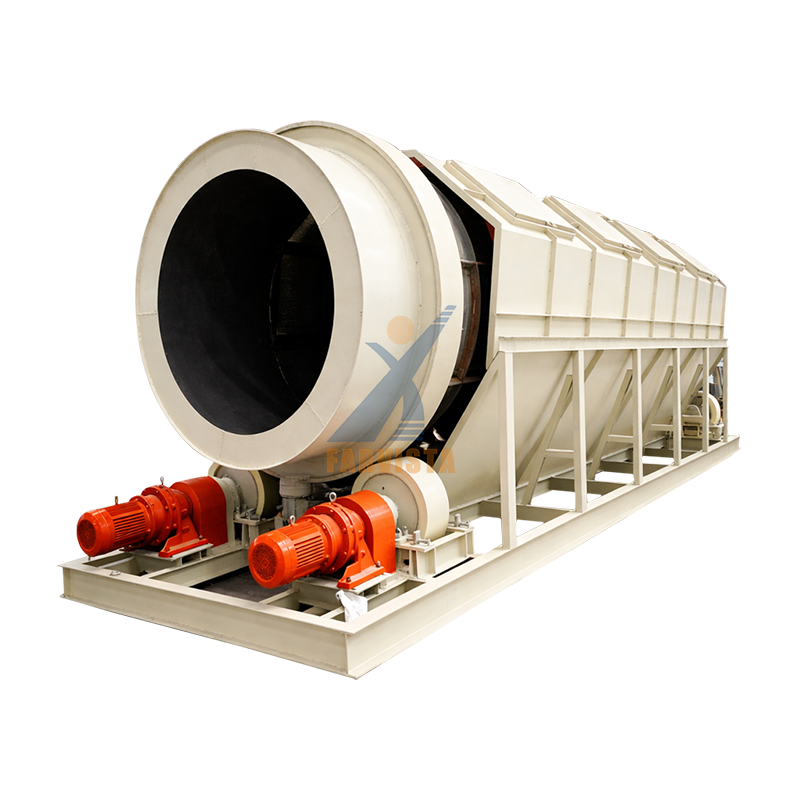
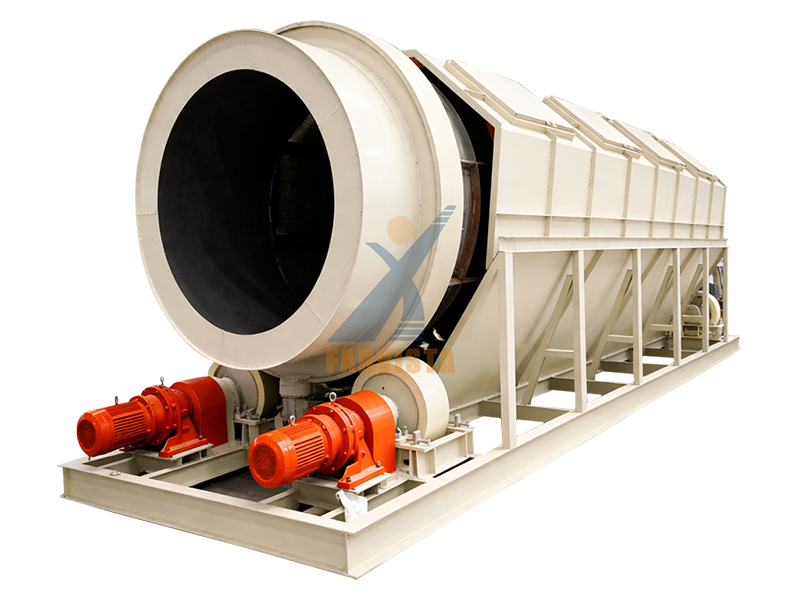
GT (W) Series Shaftless Trommel Screen for Anti-Clogging Screening
Shaftless trommel screen designed for sticky and tangled materials. Excellent anti-clogging performance, stable operation, low energy consumption, and high reliability for waste and bulk material screening.
The GT (W) Series
Shaftless Trommel Screen is a newly developed screening solution designed by
integrating the advantages of existing trommel screens while eliminating their
common limitations. Its most distinctive feature is the shaftless drum
structure, which removes the traditional central shaft found in conventional
trommel screens. The screening drum is formed by a fully integrated rolled
steel plate structure, providing a large open internal space without internal
support frameworks.
This equipment is
specifically engineered for handling complex, sticky, wet, and highly tangled
bulk materials. It is widely recognized for its outstanding anti-clogging
performance, smooth screening process, and high operational reliability. The GT
(W) Series is extensively applied in construction and demolition waste,
municipal solid waste, raw coal, sand, and aggregate screening operations.
Under challenging working conditions, it serves as an ideal upgrade and
replacement for traditional shafted trommel screens.
The GT (W) Series
Shaftless Trommel Screen can be used as a key pre-treatment and primary
screening unit. It effectively separates usable materials from interfering
impurities and classifies materials by particle size, creating favorable
conditions for subsequent fine processing stages.
Main Structure and Components
Shaftless Screening Drum
The shaftless
screening drum is the core working component of the equipment. It is
manufactured from high-wear-resistant steel plates such as NM360 or NM400,
rolled into a fully integrated cylindrical structure. Based on screening
requirements, various aperture shapes and sizes are precisely formed by laser
cutting or drilling. The drum features a continuous, unobstructed internal
space with no internal shaft or support frame, effectively eliminating material
entanglement points.
Supporting Rollers
Both ends of the
screening drum are supported by multiple sets of heavy-duty rubber tires or
polyurethane rollers. These rollers provide stable support and allow smooth and
continuous rotation of the drum under heavy loads.
Drive System
The drive system
typically consists of an electric motor, gearbox, and chain or gear
transmission. One or multiple supporting rollers are driven through friction to
rotate the screening drum. This design ensures stable torque transmission while
maintaining a simple and reliable mechanical structure.
Machine Frame
The machine frame is
a robust welded steel structure used to install the supporting rollers, drive
system, and dust sealing covers. It provides sufficient strength and rigidity
to ensure long-term stable operation under continuous load conditions.
Feeding Hopper and Discharge Chutes
The feeding hopper
guides materials smoothly into the screening drum. After screening, materials
of different particle sizes are discharged separately through internal guide
plates or external chutes, typically divided into oversize, middle-size, and
undersize material outlets.
Cleaning System (Optional or Standard)
To prevent fine or
sticky materials such as clay from clogging the screen apertures, the equipment
can be equipped with elastic cleaning balls or rotating brush systems. These
devices continuously clean the screen surface during operation, ensuring open apertures
and stable screening efficiency.
Dust Sealing Cover
A fully enclosed or
semi-enclosed dust cover can be installed to effectively control dust emission
and meet environmental protection requirements.
Application Industries
Construction and Demolition Waste Recycling
This is the core
application scenario of the GT (W) Series. It is used to screen demolition
waste, separating soil, broken concrete, bricks, and effectively removing
tangled materials such as plastics, wood, textiles, and wires.
Municipal Solid Waste Treatment
Applied in aged
waste screening and municipal waste pre-sorting processes, separating organic
materials, combustibles, and inert materials.
Coal Industry
Used for screening
and dewatering of raw coal and ROM coal. The shaftless design effectively
handles impurities such as wood chips, ropes, and cables commonly found in coal
materials.
Sand and Aggregate Industry
Suitable for
cleaning and grading natural sand, river gravel, and aggregates.
Soil Remediation and Composting
Applied in
contaminated soil screening, sludge treatment, and compost product screening.
Energy and Biomass Industry
Used for screening
and impurity removal of biomass fuels such as wood chips and agricultural
residues.
Applicable Materials
Especially suitable
for sticky, wet, tangled, and compositionally complex bulk solid waste
materials. It is also applicable to conventional materials such as sand,
aggregates, ores, and coal.
Performance Advantages and Features
Outstanding Anti-Clogging and Anti-Wrapping
Performance
The shaftless design
completely eliminates central anchoring points for material entanglement. Long,
fibrous, and strip-shaped impurities pass through smoothly without wrapping,
significantly reducing clogging risks.
High and Stable Screening Efficiency
With the assistance
of cleaning systems and smooth material flow, screening efficiency remains
consistently high throughout the operation cycle, avoiding rapid efficiency
decline caused by blockage.
Large Throughput and Strong Adaptability
High drum volume
utilization allows the equipment to handle large and fluctuating material
flows. It shows superior tolerance to high moisture content materials compared
to vibrating screens.
Energy-Saving and Environmentally Friendly
Equipped with
low-power motors (typically 5.5–30 kW), energy consumption is only about
60%–70% of that of vibrating screens. Enclosed structures effectively control
dust emission.
Smooth Operation, Low Noise, and Reduced Wear
Operating at low
rotational speeds (typically 10–15 rpm), the machine runs smoothly with
significantly lower noise and vibration than vibrating screens. Material
interaction with the screen surface is mainly sliding friction, resulting in
reduced wear.
Easy Maintenance and Long Service Life
The simple
mechanical structure means fewer failure points. Main wear parts are the
screening drum and supporting rollers, which are easy to replace. The absence
of complex vibration exciters or central shafts further improves reliability
and service life.