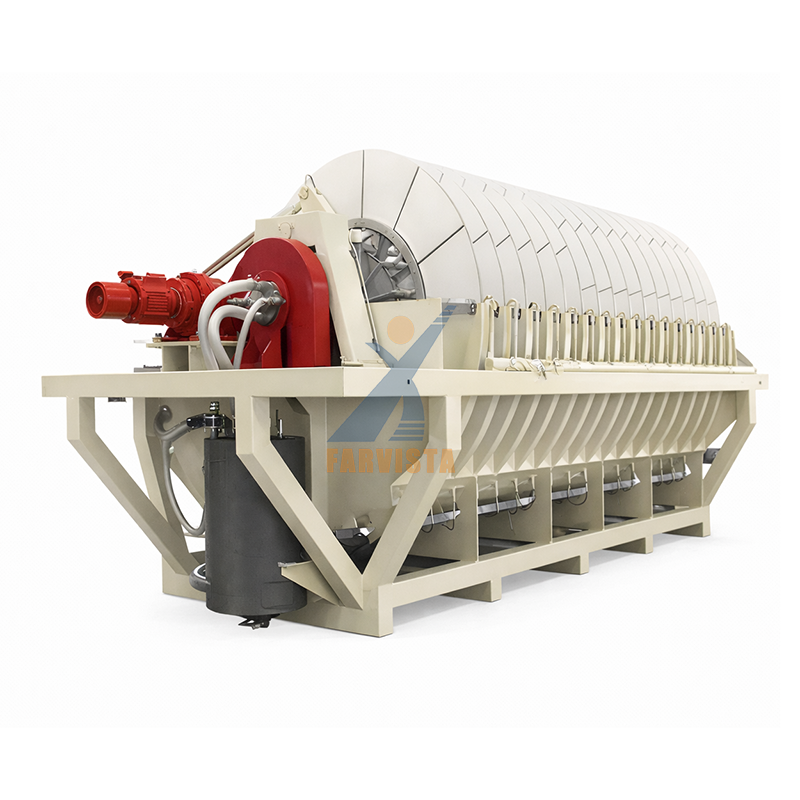
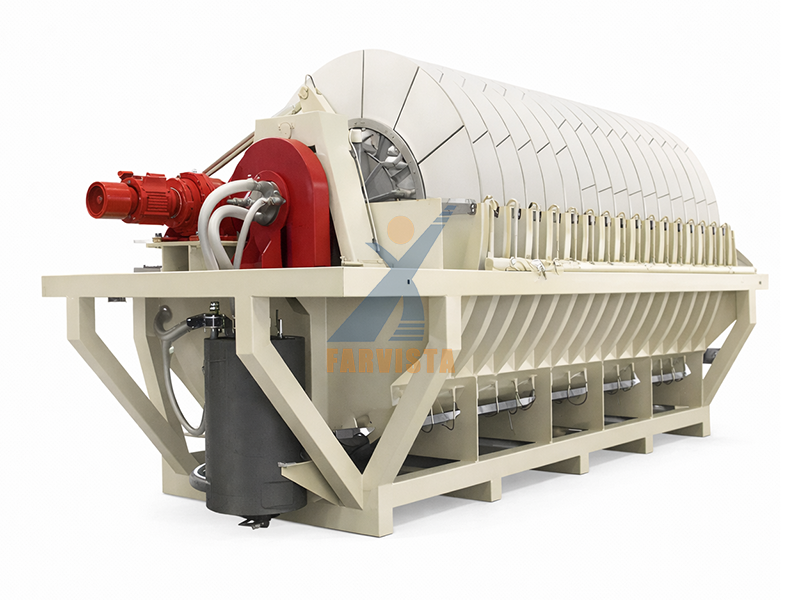
High-capacity continuous disc vacuum filter designed for mineral concentrates, featuring stable operation, low energy consumption, high automation, and reliable dewatering performance for coarse and fast-settling slurries.
GPT Series Disc Vacuum Filter – Product Introduction
The GPT Series Disc Vacuum Filter is a continuous,
high-efficiency vacuum dewatering machine widely applied in mineral processing,
coal preparation, metallurgy, and various industrial solid–liquid separation
processes. Known for its compact structure, large effective filtration area, stable
operation, and relatively low operating cost, the GPT disc filter has become a
standard solution for concentrate dewatering in large and medium-scale
processing plants.
Unlike batch
filtration equipment, the disc vacuum filter operates continuously. Multiple
filter discs rotate synchronously in a slurry tank, completing the entire
filtration cycle — including cake formation, dewatering, optional washing, cake
discharge, and filter cloth cleaning — without interruption. This continuous
operating mode ensures stable throughput, uniform product quality, and
efficient integration into modern automated beneficiation circuits.
The GPT Series is
especially suitable for materials with good
settling characteristics, relatively coarse particle size, and low
compressibility, making it an ideal choice for the final solid–liquid
separation stage before concentrate storage, transportation, or downstream
processing.
Working Principle
The filtration
process of the GPT Series Disc Vacuum Filter is driven by vacuum suction. Each
disc consists of multiple sector-shaped filter plates covered with filter
cloth. During operation, the lower portion of the rotating discs is immersed in
the slurry tank.
As the disc enters
the filtration zone, vacuum pressure draws liquid through the filter cloth and
filter plates, while solid particles are retained on the surface to form a
filter cake. As rotation continues, the cake is further dewatered in the
dewatering zone under sustained vacuum. Depending on process requirements, a
washing zone may be included to remove soluble impurities from the cake.
When the disc
reaches the discharge zone, vacuum is cut off and replaced with compressed air
(or atmospheric pressure), allowing the dried filter cake to be discharged by
scraper blades. Immediately afterward, the filter cloth enters the cleaning
zone, where high-pressure water or air removes residual solids, ensuring
consistent filtration performance in the next cycle.
Main Structural Components
1. Main Shaft and Disc Assembly
A horizontal hollow
main shaft runs through the machine and supports multiple filter discs. Each
disc is assembled from several sector-shaped filter plates (typically 8–12
sectors per disc), providing a large effective filtration area. Internal
channels in the shaft collect filtrate from each sector and guide it to the
distribution head.
2. Slurry Tank
A semi-cylindrical
slurry tank holds the feed pulp. The immersion depth of the discs can be
adjusted to optimize cake thickness and filtration efficiency under different
operating conditions.
3. Distribution Head (Core Control Component)
Located at one end
of the main shaft, the distribution head precisely controls vacuum application,
air blow-off, and zone switching. Internally divided into filtration,
dewatering, discharge, and cleaning zones, it ensures accurate and reliable
process control throughout continuous operation.
4. Vacuum System
The vacuum system
consists of vacuum pumps, gas–liquid separators, and associated pipelines. It
provides stable negative pressure for filtration and dewatering while
effectively separating air and filtrate to protect downstream equipment.
5. Cake Discharge System
Scraper blades
positioned at the discharge zone remove the dried filter cake from the filter
cloth efficiently and consistently, minimizing residual solids and reducing
cloth wear.
6. Filter Cloth Cleaning System
High-pressure water
spray or compressed air nozzles clean the filter cloth after cake discharge,
preventing pore blockage and maintaining long-term filtration performance.
7. Drive System
A speed-controlled
drive unit rotates the main shaft and disc assembly at a low, adjustable speed
to match different slurry properties and capacity requirements.
8. Frame and Auxiliary Systems
A rigid structural
frame supports the entire machine, combined with automatic feed, filtrate
discharge, and instrumentation systems for stable and safe operation.
Application Industries
Mineral Processing (Typical Application)
The GPT Series Disc
Vacuum Filter is widely used for dewatering iron concentrate, copper
concentrate, lead-zinc concentrate, sulfur concentrate, and other metallic
mineral products. It is a standard configuration in traditional large-scale
beneficiation plants.
Coal Preparation
Applied to flotation
clean coal and fine coal slurry dewatering.
Metallurgical and Chemical Industries
Suitable for
dewatering crystalline products, precipitates, catalysts, and intermediate
materials.
Non-Metallic Minerals and Building Materials
Used for quartz
sand, feldspar, phosphogypsum, and similar materials with good filtration
properties.
It is not
recommended for highly viscous, ultra-fine, colloidal, or extremely
compressible materials, where pressure filtration equipment may be more
appropriate.
Performance Advantages
Continuous Operation: Stable capacity with no
batch interruptions
High Filtration Efficiency: Large effective
filtration area in a compact footprint
Low Energy Consumption: Vacuum-driven process
with optimized system design
High Automation Level: Easy integration with
modern control systems
Reliable and Proven Technology: Long service
life and stable performance
Low Operating Cost: Reduced labor demand and
maintenance requirements
Typical Application Position in Processing Lines
The GPT Series Disc
Vacuum Filter is commonly installed as the final
dewatering stage before concentrate stockpiling, transport, drying, or
packaging, ensuring product moisture content meets handling and economic
requirements.