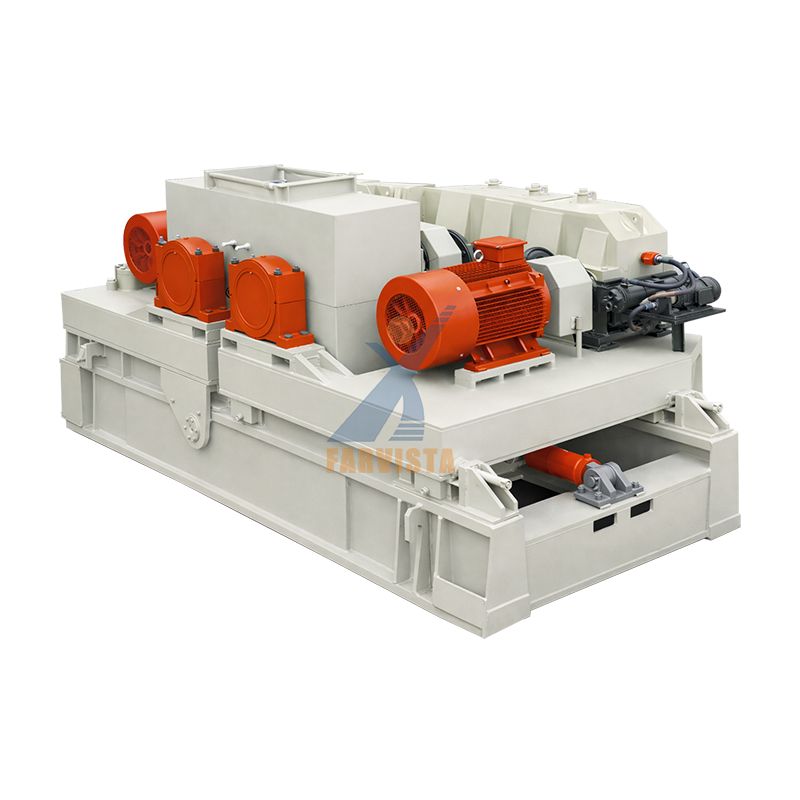
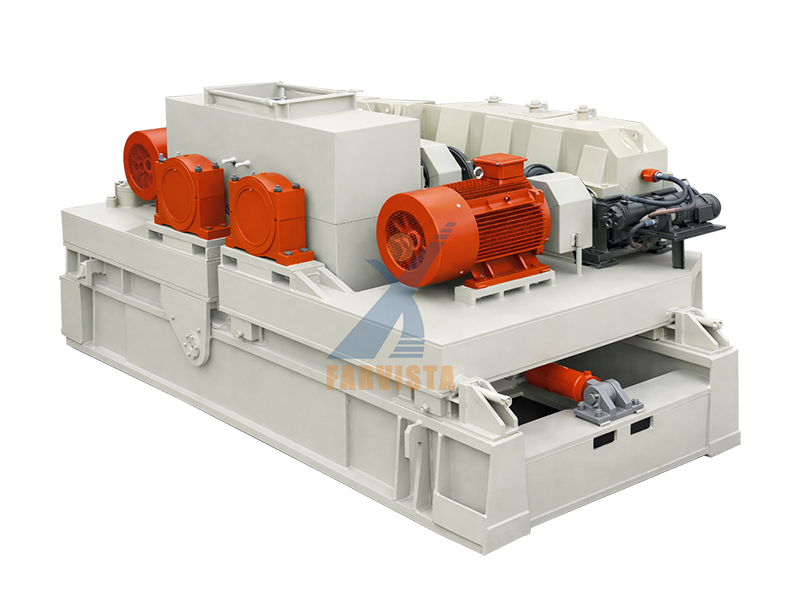
FY / FSF Series Double Roller Crusher for Controlled Crushing
The FY/FSF Series Double Roller Crusher features low over-crushing rate, uniform product size, reliable overload protection, and precise roll gap adjustment, making it ideal for controlled crushing of medium to low hardness materials.
The FY / FSF Series Double Roller Crusher is a
crushing solution developed by our company based on extensive market research
and continuous improvement of traditional roll crusher designs. By integrating
the proven advantages of similar equipment and optimizing key structural
components, this series delivers stable performance, low fines generation, and
precise product size control.
Unlike impact-based
crushing equipment, the FY/FSF Series utilizes two
counter-rotating rollers to crush materials mainly through compression and limited shearing. This working
principle effectively minimizes excessive fines, ensuring a narrow and uniform
particle size distribution. As a result, the equipment is especially suitable
for applications where strict control of product granularity and low
over-crushing rate are required.
Working Principle
The crusher consists
of two cylindrical rollers rotating in opposite directions. Material fed into
the crushing chamber is drawn between the rollers and subjected to compressive
force. Once the material strength is exceeded, it fractures along natural weak
points rather than being shattered by high-speed impact. This controlled
crushing mechanism significantly reduces powder generation and preserves the
integrity of the product particles.
One roller is fixed
in position, while the other is mounted on a sliding mechanism. The gap between
the rollers, which determines the final product size, can be accurately
adjusted according to process requirements.
Main Structural Components
Frame
The rigid frame
serves as the main supporting structure of the crusher. It is designed with
sufficient strength and stiffness to withstand continuous crushing forces and
long-term operation under industrial conditions.
Rollers
The rollers are the
core working components of the crusher:
Fixed Roller: The bearing housing is firmly
mounted to the frame, providing stable support during operation.
Movable Roller: Installed on sliding guide
rails and supported by heavy-duty springs or hydraulic cylinders, allowing
controlled movement during overload conditions.
Drive System
The drive system
typically consists of an electric motor, V-belt drive or reducer, and a pair of
large synchronized gears. One roller acts as the driving roller, while the
second roller is driven through gear engagement. This configuration ensures
synchronous rotation, stable transmission, and reliable torque distribution.
Adjustment System
The roll gap can be
adjusted by adding or removing shims or by regulating hydraulic pressure,
enabling precise control of the discharge size. This adjustment mechanism
allows operators to respond quickly to changing production requirements.
Overload Protection System
A spring or
hydraulic overload protection device is incorporated to prevent damage caused
by uncrushable materials such as iron pieces. When such objects enter the
crushing chamber, the movable roller is forced backward, temporarily increasing
the roll gap and allowing the foreign material to pass through. Afterward, the
roller automatically returns to its original position.
Application Industries
Coal Industry
Widely used for
crushing raw coal and coke while minimizing fines generation, making it ideal
for coal preparation plants and coking facilities.
Cement Industry
Suitable for
crushing cement clinker, limestone, clay, and other raw materials where
consistent particle size is required.
Chemical and Metallurgical Industries
Applied in crushing
coke, slag, quartz, and various medium to low hardness chemical raw materials
and metallurgical additives.
Building Materials and Ceramics
Used in fine
crushing processes for ceramic raw materials, glass batch materials, and
applications requiring strict powder content control.
Laboratory and Small-Scale Production
Thanks to its simple
structure, ease of operation, and precise particle size control, the crusher is
also suitable for laboratory testing and small-scale production lines.
Applicable Materials
The FY/FSF Series
Double Roller Crusher is suitable for medium and
low hardness brittle materials, including but not limited to coal, coke,
limestone, gypsum, marl, and various chemical raw materials.
It is not recommended for high-hardness or highly
abrasive materials such as granite or basalt.
Performance Advantages
Low Over-Crushing Rate and Uniform Product Size
The
compression-based crushing method ensures minimal fines generation and a
concentrated particle size distribution, which is the most significant
advantage of this equipment.
Simple Structure and Easy Maintenance
With a clear
mechanical layout and fewer complex components, routine maintenance and
replacement of wear parts such as roller surfaces can be carried out easily.
Reliable Operation and Sensitive Overload Protection
The spring or
hydraulic protection system effectively prevents severe damage caused by
foreign objects, ensuring safe and stable operation.
Flexible and Precise Product Size Adjustment
The roll gap can be
adjusted quickly and accurately, allowing operators to control product size
with high precision.
Low Dust Emission
Compared with
high-speed impact crushers, the low-speed compression crushing process
generates significantly less dust, contributing to improved environmental
performance.