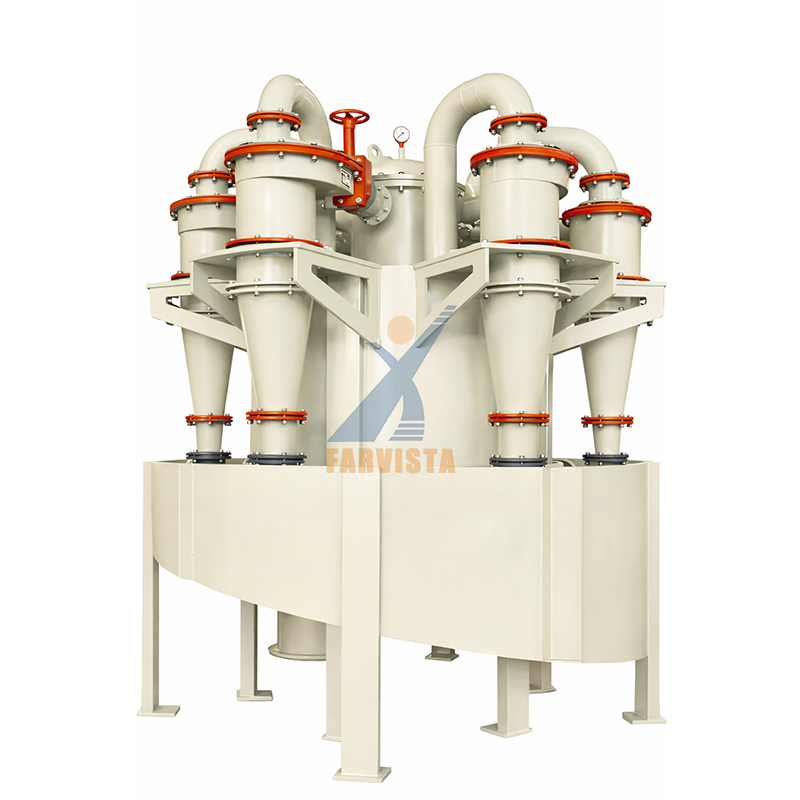
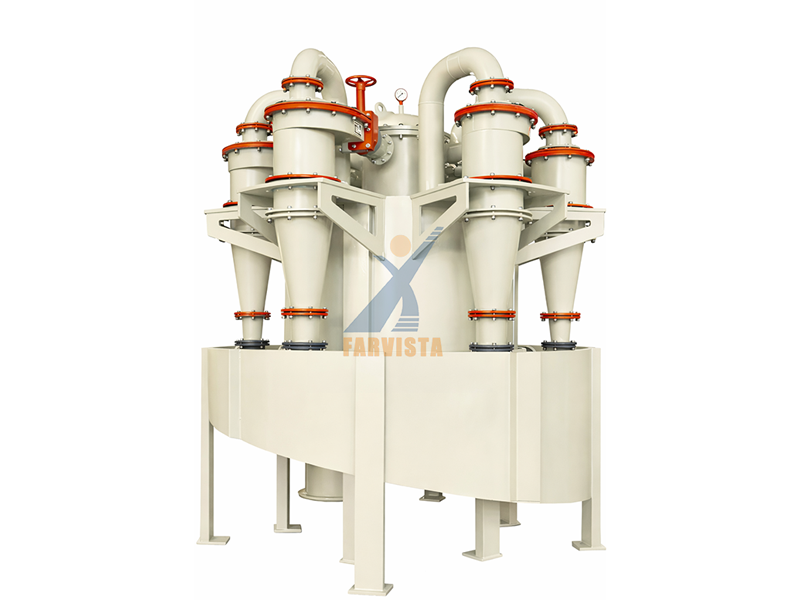
FX Series High-Efficiency Hydrocyclone Cluster for Classification & Separation
The FX Series Hydrocyclone Cluster delivers high-efficiency classification and solid-liquid separation through a compact, modular design with no moving parts, ensuring stable operation, large capacity, and precise particle size control.
The FX Series Hydrocyclone Cluster is a modular
classification and separation system composed of multiple hydrocyclones
arranged in parallel or series configurations. Renowned for its exceptional classification efficiency, compact
structure, large processing capacity, and absence of moving parts, the
FX Series has become a core piece of equipment in modern mineral processing,
coal preparation, aggregate production, environmental protection, and chemical
industries.
Based on the
principle of centrifugal sedimentation,
the hydrocyclone cluster generates a strong rotational flow field inside each
cyclone, enabling rapid and efficient separation of particles with different
sizes and densities. Compared with traditional mechanical classifiers,
hydrocyclones offer faster response, higher separation sharpness, and
significantly lower maintenance requirements, making them indispensable in
continuous industrial processes.
As a primary classification unit in closed-circuit grinding
systems, and a critical component for desliming, thickening, and
separation stages, the FX Series Hydrocyclone Cluster plays a decisive role in
improving overall process efficiency, product consistency, and operational
stability.
Structural Composition
The FX Series
Hydrocyclone Cluster is engineered as an integrated, rigid assembly that
combines multiple functional modules into a single, reliable system.
Hydrocyclone Units (Core Elements)
Each hydrocyclone
features a conical-cylindrical structure and is typically manufactured from:
Wear-resistant
polyurethane
Ceramic materials
Rubber-lined steel
shells
A standard
hydrocyclone consists of:
Cylindrical section
Conical section
Feed inlet
Overflow pipe
(vortex finder)
Underflow nozzle
(apex / spigot)
This optimized
geometry ensures stable internal flow patterns and high separation accuracy
under varying operating conditions.
Feed Distribution Manifold (Key Component)
The feed distributor
ensures that incoming slurry is evenly,
steadily, and pressure-balanced to each hydrocyclone. Uniform feed
distribution is critical to maintaining consistent classification performance
across the entire cluster and preventing efficiency losses caused by unequal
loading.
Overflow Collection Launder
All fine particle
products discharged from the overflow outlets are collected through a
centralized launder system, ensuring smooth downstream transport and preventing
turbulence or material buildup.
Underflow Collection Hopper or Trough
Coarse particles
discharged from the underflow outlets are collected through a dedicated hopper
or launder, allowing easy integration with subsequent grinding, screening, or
dewatering equipment.
Rigid Steel Frame
All hydrocyclones,
manifolds, and collection systems are mounted on a heavy-duty steel frame,
providing:
Structural stability
Accurate alignment
Ease of installation
and maintenance
The modular design
allows flexible configuration according to capacity and process requirements.
Valves and Instrumentation
To ensure precise
control and monitoring:
Observation spigots
or pressure indicators can be installed at individual underflow outlets
Pressure gauges and
flow meters are commonly installed on the feed pipeline
These instruments
enable real-time monitoring of operating conditions and quick troubleshooting.
Application Industries
Mineral Processing Industry
Closed-circuit grinding classification Used in combination with ball mills to separate qualified fine particles
from mill discharge, while returning coarse particles for regrinding—essential
for improving grinding efficiency and controlling product fineness.
Desliming Removes ultra-fine slimes prior to gravity separation or flotation,
significantly improving downstream separation performance.
Pre-thickening Performs initial slurry concentration before thickening or filtration
stages.
Dense medium recovery Widely used for recovering heavy media such as magnetite in dense medium
separation circuits.
Coal Preparation Industry
Applied in coal
slurry classification, thickening, and clarification processes, contributing to
improved water recovery and reduced environmental discharge.
Aggregate and Manufactured Sand Industry
Manufactured sand classification Controls fineness modulus and separates excess stone powder to meet
concrete and mortar specifications.
Fine sand recovery systems Serves as the core classification unit in integrated fine sand recovery
equipment.
Environmental Protection and Chemical Industry
Used in industrial
wastewater treatment for solid-liquid separation and classification of
particles with different densities and sizes.
Key Advantages
Extremely high
classification efficiency
Large processing
capacity with compact footprint
No moving parts,
resulting in low maintenance and high reliability
Flexible modular
configuration for various process requirements
Stable operation
under high-pressure and high-concentration slurry conditions