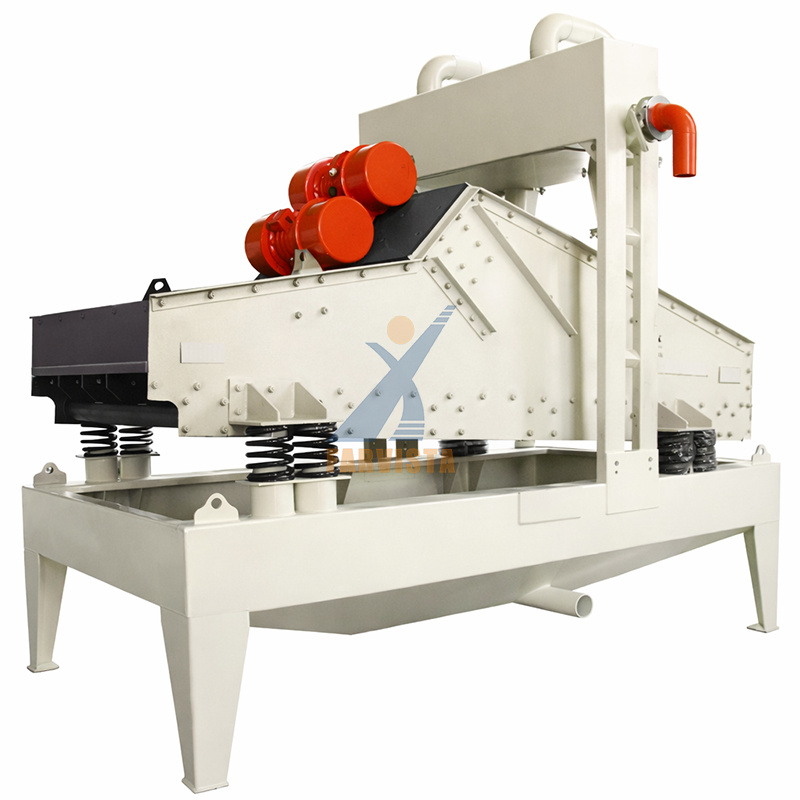
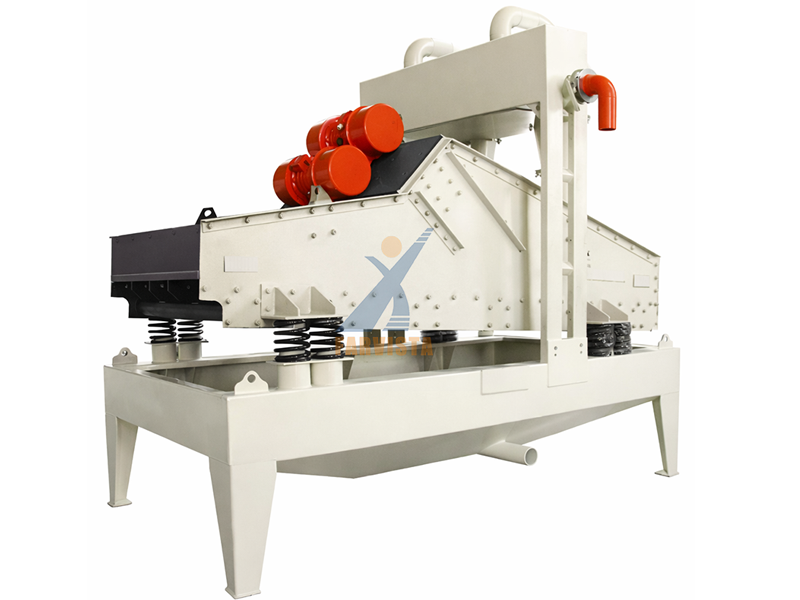
Fine Sand Recovery Machine for Aggregate and Mineral Processing
A compact recovery solution designed to capture fine sand above 0.075 mm from slurry streams. Effectively reduces sand loss, improves product grading, lowers settling pond load, and enhances overall plant efficiency.
The Fine Sand Recovery Machine is a specialized
process unit designed to recover valuable fine sand particles from slurry
streams generated in sand washing, mineral processing, and wet classification
systems. Its primary function is to intercept
and reclaim fine particles—typically larger than 0.075 mm—that would otherwise
be lost with wastewater, thereby improving product yield, stabilizing
particle size distribution, and reducing environmental and operational burdens.
In conventional wet
processing plants, fine sand loss is a common and costly problem. During
washing and classification, a significant portion of usable fine material is
discharged together with process water into settling ponds or tailings systems.
This not only lowers the output of saleable products but also increases
sediment accumulation, water treatment costs, and environmental compliance
pressure.
The Fine Sand
Recovery Machine addresses these issues by introducing a targeted recovery step
between washing equipment and wastewater discharge. Rather than replacing
washing or screening equipment, it functions as a dedicated recovery module, focused on reclaiming fine sand and
returning it to the production cycle.
Working Principle
The Fine Sand
Recovery Machine operates based on hydraulic
classification using centrifugal force.
Slurry containing
water, fine sand, and ultra-fine particles is fed into the system—typically
from the overflow of sand washers, classifiers, or process sumps. The slurry
enters a hydrocyclone, where centrifugal
force rapidly separates particles according to size and density.
Recovered fine sand
particles are concentrated in the cyclone underflow and discharged as a
high-solids stream. These recovered solids can then be returned directly to the
sand pile, blended with coarser aggregates, or sent to downstream handling
equipment such as dewatering screens, stockpiles, or conveyors, depending on
process requirements.
The cyclone
overflow, containing water and ultra-fine particles, is routed back to settling
ponds, clarification systems, or recycling circuits with a significantly
reduced solid load.
Main Components
Hydrocyclone Assembly
The core separation
element, responsible for classifying slurry and concentrating recoverable fine
sand. Manufactured from wear-resistant materials to ensure long service life
under abrasive conditions.
Feed and Distribution System
Guides slurry
smoothly into the hydrocyclone, ensuring stable pressure and uniform flow for
consistent recovery performance.
Support Frame and Structural Base
A compact steel
structure supporting the cyclone and piping components. Designed for easy
installation alongside existing sand washing or processing lines.
Discharge Chutes and Piping
Direct recovered
fine sand and clarified overflow to designated locations without disrupting
upstream or downstream operations.
(Note: Unlike integrated recovery–dewatering systems,
the Fine Sand Recovery Machine focuses on separation and recovery. Deep
dewatering may be handled by downstream equipment if required.)
Applications
Sand and Aggregate Production Plants
Recovery of fine
sand lost from wheel sand washers, spiral washers, or log washers.
Improvement of
finished sand grading and compliance with construction standards.
Reduction of
material loss in traditional wet processing lines.
Dry Sand Production Systems
Recovery of fine
particles generated by crushers and air classifiers when water-based recovery
is applied.
Mining and Mineral Processing
Recovery of valuable
fine particles from tailings slurry or process water streams.
Support equipment
for beneficiation circuits where fine material loss is unacceptable.
Coal Preparation and Washing Plants
Recovery of fine
coal particles from slurry water to improve overall resource utilization.
Environmental and Wastewater Management
Reduction of
suspended solids entering settling ponds.
Lower sludge
accumulation and dredging frequency.
Performance Advantages
Effective Fine Sand Recovery
Specifically
designed to capture particles that are too fine for traditional screens but too
valuable to discard. Recovery rates typically exceed 80–90% for target size
ranges.
Simple Structure and Reliable Operation
With minimal moving
parts and no complex mechanical drives, the system operates reliably under
continuous duty with low maintenance requirements.
Compact Footprint and Easy Integration
Can be installed
directly into existing plants with minimal modification. Ideal for upgrading
older production lines suffering from excessive sand loss.
Reduced Environmental Load
By removing a large
proportion of solids from wastewater, the system significantly decreases the
burden on settling ponds and clarification systems.
Cost-Effective Investment
Recovered fine sand
represents immediate economic value. In many cases, the equipment pays for
itself through material recovery within a short operating period.
Typical Operating Conditions
Feed slurry
concentration: 5%–25% solids
Optimal recovery
particle size: ≥0.075 mm
Compatible with
variable flow rates under stable operating pressure
Role in Modern Processing Plants
The Fine Sand
Recovery Machine is not intended to replace washing, screening, or dewatering
equipment. Instead, it serves as a critical
auxiliary recovery unit, bridging the gap between production efficiency
and environmental responsibility.
By reclaiming fine
sand that would otherwise be wasted, producers gain higher output, better
product quality, and improved sustainability—without fundamentally altering
their existing process layout.
Conclusion
The Fine Sand Recovery Machine provides a focused,
efficient, and economically sound solution to one of the most persistent
challenges in wet processing systems: fine sand loss. Its ability to recover
valuable material, reduce environmental impact, and integrate seamlessly into
existing plants makes it an essential component for modern aggregate and
mineral processing operations.