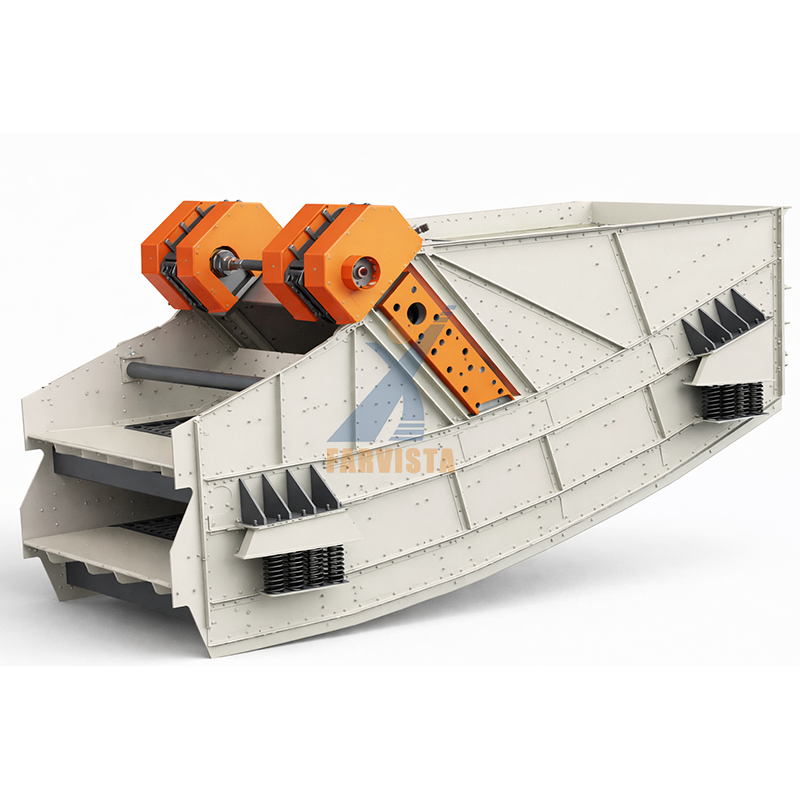
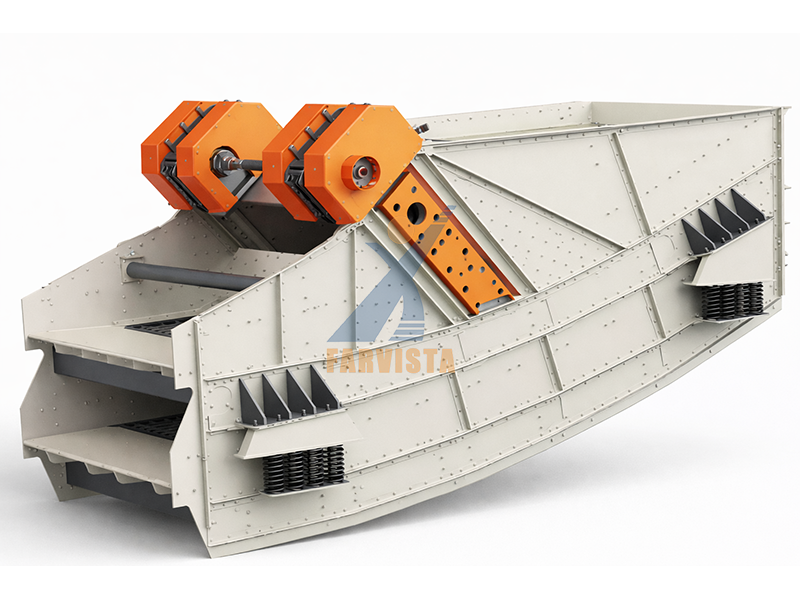
BRL Series Banana Screen for High-Capacity and Constant Bed Thickness Screening
The BRL Series Banana Screen offers extremely high capacity and stable screening accuracy through constant bed thickness technology, making it ideal for large-scale mining, coal preparation, and aggregate plants.
The BRL Series
Banana Screen, also known as a constant bed thickness screen, is a
high-performance screening equipment developed to meet the increasing demands
for large capacity, high efficiency, and stable screening accuracy in modern
mining and processing plants. It is named after its distinctive “banana-shaped”
profile, formed by multiple screen deck sections installed at different
inclination angles.
The core design
concept of the BRL Series is constant bed thickness screening. Unlike
conventional linear vibrating screens, where the material bed is thick at the
feed end and gradually becomes thinner toward the discharge end, the banana
screen maintains a relatively uniform material bed thickness along the entire
screening surface. This is achieved through a progressive reduction of deck
inclination angles combined with optimized vibration parameters.
At the feed end, the
steep inclination allows material to accelerate rapidly, preventing excessive
accumulation and overloading of the screen surface. As the material moves
forward, the inclination angle decreases step by step, reducing conveying speed
and allowing sufficient residence time for fine particles to pass through the
apertures. This progressive transport behavior ensures optimal screening
conditions across all deck sections, significantly improving screening
efficiency and unit-area processing capacity.
As a result, the BRL
Series Banana Screen has become the preferred solution for handling
high-throughput, medium-to-fine particle size screening tasks in large-scale
mining operations, aggregate production lines, and coal preparation plants.
Main Structure
Multi-Section Variable-Angle Screen Box
The multi-section
screen box is the defining feature of the banana screen. It typically consists
of 3 to 5 screen deck sections, each installed at a different inclination
angle. From the feed end to the discharge end, the angles decrease
progressively (for example: 35°, 25°, 15°, and 5°). The overall contour forms a
curved, banana-like shape that enables constant bed thickness screening.
High-Strength Screen Box and Cross Beams
The screen box is
manufactured using box-type beams or high-strength structural steel sections.
Welded construction ensures high rigidity and fatigue resistance under strong
inertial forces generated during high-intensity vibration. This design supports
long service life under continuous heavy-duty operation.
Dual Vibration Motors or Exciters
The vibration system
typically consists of dual vibration motors or block-type eccentric exciters
that generate strong linear excitation force. The vibration intensity (G-force)
can be adjusted to suit different material characteristics, particle sizes, and
moisture content.
High-Performance Screening Media
The BRL Series
commonly adopts polyurethane elastic screen panels or heavy-duty welded wire
screens. The modular design allows individual deck sections to be replaced
independently, reducing downtime and maintenance cost. Aperture shapes and
sizes can be customized according to application requirements.
Vibration Isolation and Support System
Composite springs or
rubber springs are used to support the screen box and isolate vibration from
the foundation. This system effectively reduces dynamic loads transmitted to
surrounding structures and improves operational stability.
Segmented Feed Box and Dust-Proof Enclosure
A segmented feed box
ensures even material distribution onto the first screen deck. Optional fully
enclosed dust covers provide effective dust control, meeting environmental
protection requirements in modern industrial plants.
Applications
Ferrous and Non-Ferrous Mining
The BRL Series
Banana Screen is widely used for pre-screening ahead of closed-circuit grinding
systems. By removing qualified fine particles from crushed products, it
significantly improves grinding mill efficiency. It is also applied in
concentrate and tailings dewatering operations.
Large-Scale Aggregate Production Lines
In sand and
aggregate plants, the banana screen is commonly used for final grading of
manufactured sand and aggregates, such as separating 0–3 mm, 3–5 mm, and 5–10
mm fractions. Its extremely high throughput makes it ideal for large-capacity
production lines.
Coal Preparation and Washing Plants (Core Application)
The BRL Series plays
a critical role in modern coal preparation plants. It is used for raw coal
sizing (e.g., 300×300 mm, 100×100 mm, 50×50 mm, 25×25 mm classifications), as
well as for desliming and dewatering after dense medium separation. Its ability
to handle large volumes reliably makes it a key equipment in coal washing
systems.
Chemical and Industrial Minerals
The banana screen is
also suitable for particle size classification of bulk materials such as
fertilizers, quartz sand, salt, and other industrial minerals produced at large
scale.
Performance Advantages and Features
Extremely High Processing Capacity
The most significant
advantage of the BRL Series Banana Screen is its outstanding capacity. The
unit-width throughput can reach 1.5 to 2.5 times that of conventional linear
vibrating screens. Under the same installation space and capacity requirements,
fewer machines or smaller models are needed.
Stable Screening Accuracy and Product Consistency
Constant bed
thickness screening minimizes near-mesh effects and reduces screen blinding.
This results in stable screening accuracy and consistent product size
distribution.
Excellent Adaptability to Difficult Materials
The BRL Series
performs particularly well when handling materials with higher moisture content
or higher fine particle ratios. Its anti-blinding and anti-sticking capability
is superior to conventional screens, ensuring stable long-term operation.
Robust Structure and High Reliability
Designed for
heavy-duty applications, the equipment features reinforced structures,
heavy-load bearings, and wear-resistant components. It is suitable for 24/7
continuous operation in harsh industrial environments.
Energy Efficiency per Ton of Material
Although the
installed power of a single machine may be relatively high, the exceptionally
high screening efficiency means that energy consumption per ton of processed
material is typically lower than that of conventional screening equipment.