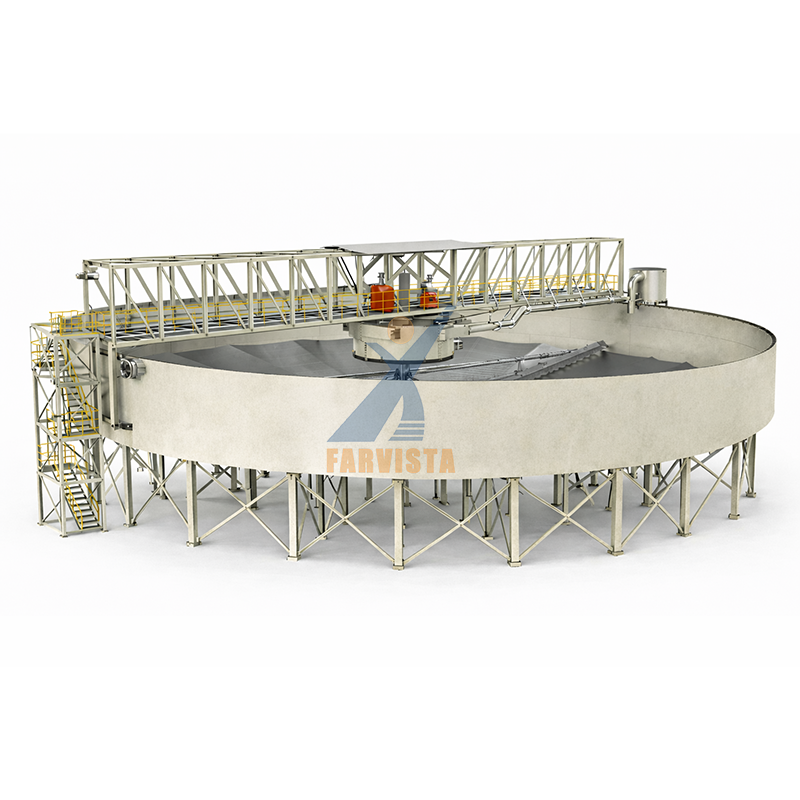
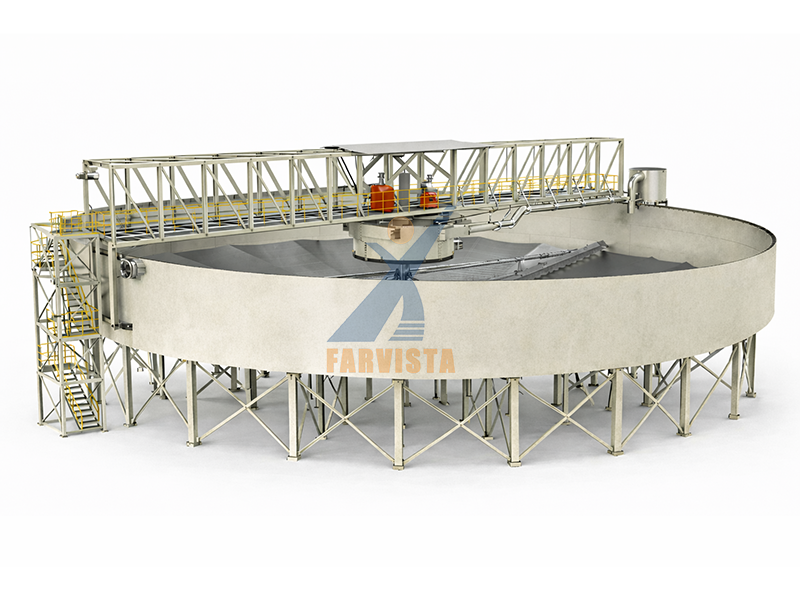
NXG Series Radial Flow Thickener for Slurry Thickening & Clarification
The NXG Series Radial Flow Thickener provides high-capacity slurry thickening and clarification through gravity sedimentation, delivering stable operation, low energy consumption, excellent overflow clarity, and reliable underflow concentration for continuous industrial processes.
The NXG Series Radial Flow Thickener is a
large-scale solid-liquid separation unit designed for efficient slurry
thickening, clarification, and dewatering in mineral processing, metallurgy,
coal preparation, chemical processing, and environmental protection industries.
Known for its large processing capacity, stable
operation, low operating cost, and excellent clarification performance,
the NXG Series has become a core thickening solution in modern industrial
plants.
Operating on the
principle of gravity sedimentation, the
radial flow thickener provides sufficient settling area and residence time for
fine solid particles to separate naturally from the liquid phase. A slowly
rotating rake mechanism gently moves the settled thickened solids (underflow)
toward the central discharge cone, while clarified liquid overflows uniformly
along the peripheral weir, producing high-quality return water.
As a critical process hub connecting grinding and separation
circuits, or tailings disposal and water recovery systems, the NXG Series
functions not only as a concentration unit but also as a buffer tank that stabilizes downstream
operations and a water-saving center that
significantly reduces fresh water consumption and tailings transport volume.
Structural Composition
The NXG Series
Radial Flow Thickener is composed of several integrated subsystems designed for
durability, operational stability, and ease of automation.
Thickening Tank (Tank Body)
The thickening tank
is a large circular structure constructed from reinforced concrete or welded
steel plates, depending on project requirements. The tank bottom is typically
designed as a shallow cone or flat bottom with scraper blades to facilitate efficient
underflow collection.
Key features
include:
Large effective
settling area
Uniform peripheral
overflow weir and launder
Structural strength
suitable for large-diameter installations
Central Drive System (Bridge Type or Center Column
Type)
Two drive
configurations are available:
Bridge-Type Drive A truss bridge spans the tank, with the drive head mounted at the
center. This design is commonly used for small to medium diameter thickeners.
Center Column Type (Preferred for Large Units) The drive mechanism is installed on a central concrete column,
supporting the rake system through a rotating frame. This structure offers
superior stability and is widely used for large-diameter thickeners (typically
above 20 meters).
Rake Mechanism System
The rake system
consists of:
Main rake arms
Auxiliary rake
blades
The rakes rotate
slowly, typically completing one full revolution every 10–20 minutes. Their function is to gently move the settled
high-density slurry along the tank bottom toward the central discharge cone,
minimizing disturbance to the settling zone while ensuring continuous underflow
removal.
Rake Lifting Device (Core Safety System)
The drive unit is
equipped with a mechanical or hydraulic
automatic rake lifting system. When abnormal conditions occur—such as
excessive underflow accumulation, blockage, or torque overload—the rake arms
are automatically lifted to a preset height to prevent mechanical damage.
Once the load
returns to normal, the rake system automatically lowers back into operating
position, ensuring equipment safety and uninterrupted operation.
Feed System
The feed slurry
enters the thickener through a centrally located feed well. This design reduces
turbulence and evenly distributes the slurry into the settling zone, enhancing
sedimentation efficiency and improving overflow clarity.
Underflow Discharge System
The central
discharge cone at the tank bottom is connected to an underflow pump—typically a
diaphragm pump or progressive cavity pump. Underflow discharge can be
controlled continuously or intermittently using variable frequency drives or
control valves to achieve the desired underflow concentration.
Monitoring and Control System
Modern NXG Series
thickeners can be equipped with:
Sludge bed level
detectors
Torque sensors
Density meters
These instruments
enable advanced automation strategies, allowing stable, unattended operation
and consistent product quality.
Application Industries
Mineral Processing
Concentrate thickening Increases flotation concentrate density prior to filtration and drying.
Tailings thickening Significantly raises tailings slurry concentration, enabling
high-density transport or dry stacking, reducing tailings storage volume,
improving safety, and maximizing water recovery.
Intermediate slurry thickening Used for hydrocyclone overflow or leaching feed preparation.
Coal Preparation
Applied for
thickening and clarification of coal slurry, improving wash water recovery and
reducing discharge.
Metallurgy and Chemical Industry
Used for thickening
and dewatering red mud, gypsum, and various chemical precipitates.
Environmental Protection & Water Treatment
Widely used for
sludge thickening in municipal wastewater treatment plants and solid-liquid
separation in industrial wastewater systems.
Other Industries
Including building
materials, paper making, and food processing industries for slurry
concentration and waste reduction.
Suitable Feed Characteristics
The NXG Series
Radial Flow Thickener is particularly suitable for slurries with:
Fine particle size
distribution (typically a high proportion of -200 mesh particles)