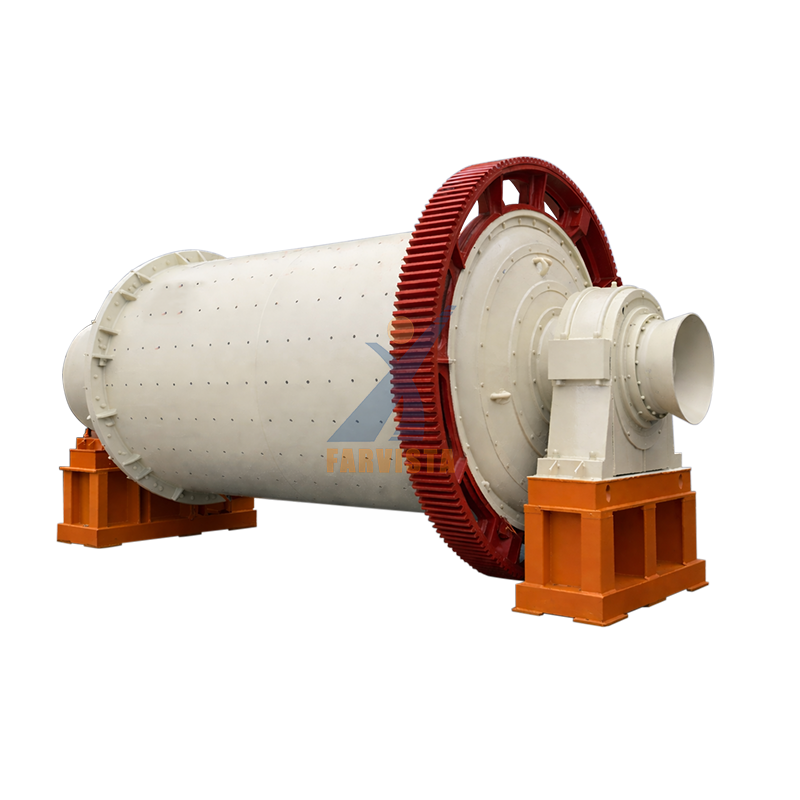
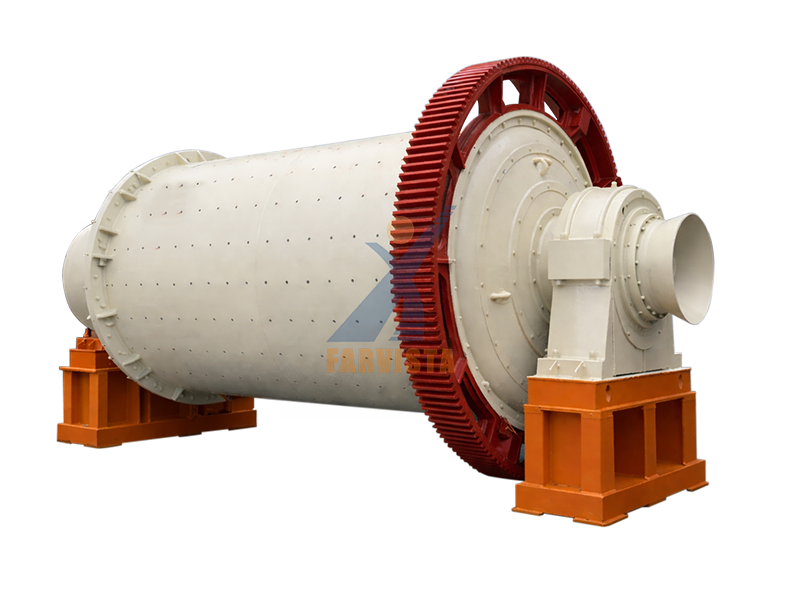
FMQY Series Wet Overflow Ball Mill for Fine and Ultrafine Grinding
Designed for fine and ultrafine grinding, the FMQY Wet Overflow Ball Mill delivers uniform product size, stable operation, and seamless integration with hydrocyclone closed-circuit systems.
The FMQY Series Wet
Overflow Ball Mill is a core grinding equipment widely used in mineral
processing, non-metallic mineral beneficiation, chemical processing, and new
material industries where fine and ultrafine grinding is required. With its
mature design, stable structure, and proven process performance, this type of
ball mill has become a standard solution in modern concentrators and wet
grinding plants.
The mill operates
based on the impact, abrasion, and grinding action generated by steel grinding
media inside a rotating cylindrical shell. During operation, water is
introduced into the mill to form a slurry with the feed material. As the
cylinder rotates at a speed lower than the critical speed, the grinding media
are lifted and dropped repeatedly, efficiently reducing the material particle
size through continuous impact and grinding. Under typical operating
conditions, the product size can reach −0.074 mm or finer, meeting the
requirements of fine liberation in most beneficiation processes.
Unlike grate
discharge ball mills, the FMQY Series adopts an overflow discharge design. When
the slurry level inside the mill exceeds the height of the discharge trunnion,
finely ground material with good fluidity naturally overflows from the
discharge end, while coarse particles settle and remain in the mill for further
grinding. This inherent classification characteristic makes the wet overflow
ball mill particularly suitable for fine grinding stages and closed-circuit
grinding systems.
Main Structure
Cylindrical Shell
The shell is a large
rotating cylinder fabricated from high-quality steel plates by rolling and
welding. The length-to-diameter ratio (L/D) is typically equal to or greater
than 1.5, providing sufficient residence time for fine grinding. The inner
surface of the shell is lined with high-manganese steel liners or rubber
liners, which protect the shell from wear while enhancing grinding efficiency
by lifting the grinding media.
Feeding Section
The feeding section
consists of a feeder and a hollow feed trunnion. It ensures stable and
continuous feeding of material, often including cyclone underflow (circulating
load), together with process water. The feeding design supports smooth slurry
flow into the mill without blockage.
Discharge Section (Overflow Discharge)
The overflow
discharge section is the key structural feature distinguishing this mill from
grate-type ball mills. There is no discharge grate. Instead, a trumpet-shaped
overflow liner is installed at the discharge end. When the slurry reaches the
designed level, qualified fine particles overflow automatically, while coarse
particles remain in the grinding zone. This simple and reliable structure
significantly reduces the risk of blockage and excessive wear.
Main Bearings
The mill is
supported by large-capacity bearings, which can be either sliding bearings or
rolling bearings depending on project requirements. The bearing system is
designed to support the heavy rotating mass of the mill with stable and
reliable performance under continuous operation.
Drive System
The drive system
typically includes a high-power electric motor, a reduction gearbox, and a
girth gear with pinion. The system drives the mill to rotate at the optimal
operating speed, ensuring sufficient grinding efficiency while avoiding
excessive wear and energy loss.
Grinding Media (Steel Balls)
Grinding media are
selected and proportioned according to feed size, material hardness, and target
product fineness. Multiple ball sizes (such as Ø100 mm, Ø60 mm, Ø40 mm) are
commonly used in a reasonable ratio to achieve effective impact and grinding.
Applications
Metal Ore Processing
In flotation plants,
the FMQY Wet Overflow Ball Mill is widely used as a secondary grinding or
regrinding mill to achieve adequate mineral liberation. In gold and silver
cyanidation plants, it is used to grind ore to very fine sizes, increasing
leaching efficiency. It is also applied in magnetic separation and gravity
separation circuits where fine grinding is required.
Non-Metallic Mineral Processing
The mill is suitable
for wet grinding of quartz, feldspar, kaolin, calcium carbonate, and other
non-metallic minerals, producing fine or ultrafine products for filler and
coating applications.
Chemical and New Material Industries
It is commonly used
for wet grinding of chemical raw materials, ceramic glazes, and precursor
materials for batteries and advanced materials, where particle size control and
uniformity are critical.
Environmental and Metallurgical Applications
The equipment can be
applied in wet grinding processes prior to hydrometallurgical leaching, as well
as in the resource recovery treatment of industrial solid waste through wet
grinding methods.
Applicable Materials
The FMQY Series Wet
Overflow Ball Mill is suitable for most ores, rocks, and industrial materials
that can be processed by wet grinding. It is not recommended for materials that
react with water or processes that strictly require dry grinding.
Performance Advantages
Excellent Fine and Ultrafine Grinding Capability
The overflow
discharge design enhances fine grinding performance, making the mill
particularly effective for producing products finer than 200 mesh (0.074 mm), a
range that is difficult for grate-type ball mills to achieve efficiently.
Simple Structure and High Reliability
With no discharge
grate or complex lifting components, the discharge structure is simple and
robust, reducing potential failure points, wear parts, and maintenance
requirements.
Uniform Product Size Distribution
The natural overflow
mechanism retains coarse particles inside the mill, resulting in finer and more
uniform product size with fewer oversized particles in the discharge.
Ideal for Closed-Circuit Grinding Systems
The overflow slurry
can be smoothly connected to hydrocyclone classification systems, forming an
efficient and stable closed-circuit grinding process that is widely adopted in
modern concentrators.
Controlled Overgrinding in Closed Circuit Operation
When combined with
an efficient classification system, qualified fine particles are promptly
removed from the mill, reducing residence time and minimizing the risk of
excessive grinding.