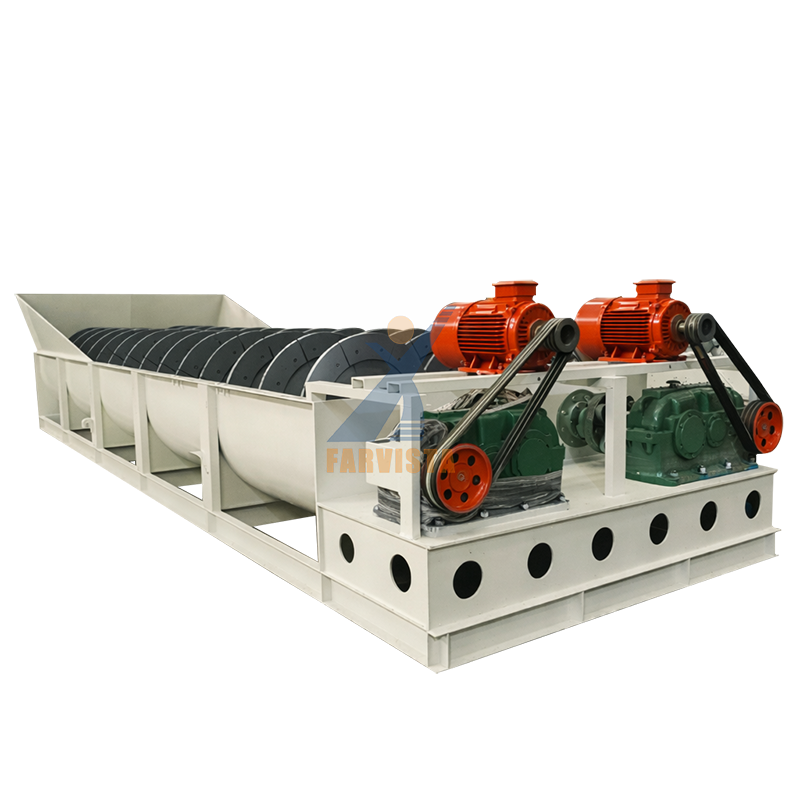
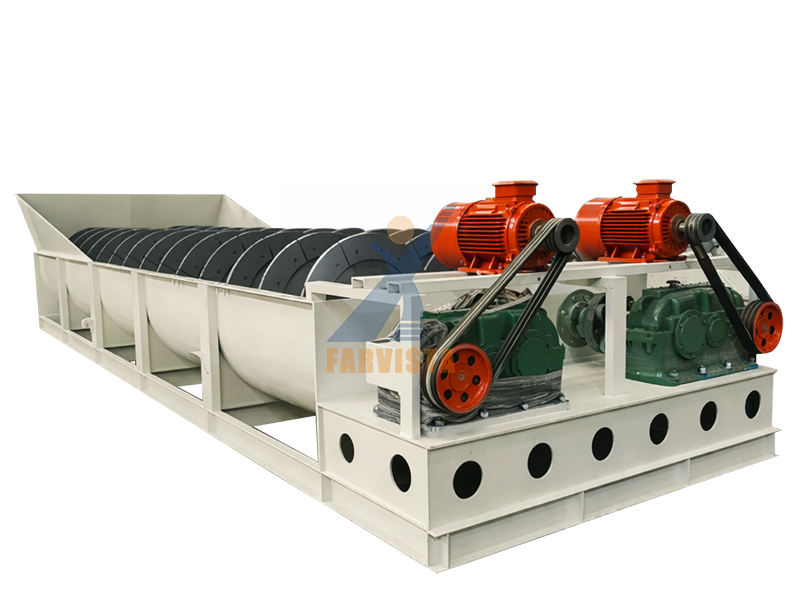
The FG & FC
Series Spiral Classifier is a mechanical classification device based on the
principle of differential settling velocity of solid particles in liquid. It
classifies materials by gravity sedimentation and continuously returns coarse
particles through a rotating spiral mechanism. This equipment is widely used in
mineral processing plants, where it forms a closed grinding circuit together
with ball mills.
Known for its
reliable structure, stable operation, low return sand moisture content, and
convenient gravity connection with ball mills, the FG & FC Series Spiral
Classifier remains an indispensable classification solution in many mineral
processing flows. Through continuous spiral rotation, the classifier agitates
and washes the slurry, mechanically lifts settled coarse particles (return
sand) back to the mill, and allows fine particles (overflow) to discharge with
the water flow.
In applications
involving coarse particle classification, stable return sand concentration, and
gravity separation processes, spiral classifiers still play an irreplaceable
role. They remain a key classification device in mineral beneficiation systems
where process stability and simplicity are prioritized.
Classification Types
According to spiral
configuration and working conditions, the FG & FC Series can be classified
as follows:
Single Spiral and Double Spiral Classifier Selected based on required processing capacity and plant layout.
High Weir Spiral Classifier Suitable for materials with overflow particle size typically between
0.83 mm and 0.15 mm. Commonly used for ore classification and sand washing
applications.
Submerged Spiral Classifier Designed for finer materials with particle sizes ranging from 0.15 mm to
0.07 mm. Widely used for fine ore and powder classification.
Main Structure and Components
The spiral
classifier mainly consists of an inclined tank and an internal spiral
mechanism.
Tank (Water Trough)
The tank is a long,
inclined trough with a semi-cylindrical bottom. The high end is equipped with
an overflow weir, while the low end serves as the return sand discharge outlet.
The inclination angle of the tank can be adjusted to meet different classification
size requirements.
Spiral Assembly
This is the core
working component of the classifier. It consists of a main shaft, support
structure, and spiral blades. The spiral blades are continuously welded onto
the support and are responsible for slurry agitation and mechanical lifting of
the return sand.
Drive System
Usually installed at
the high end of the tank, the drive system includes an electric motor and
gearbox, driving the spiral shaft at low rotational speed to ensure stable
classification performance.
Lifting Mechanism
An electric or
manual lifting mechanism is installed at the high end of the classifier. It
allows the spiral to be lifted during shutdown, facilitating equipment startup
and maintenance operations.
Lower Support and Bearing Assembly
A support base and
lower bearing are installed at the low end of the tank to support the lower end
of the spiral shaft and ensure smooth operation.
Application Industries
Metallic Mineral Processing
Used in primary
grinding-classification circuits where coarse particle size (typically overflow
fineness >0.15 mm) and stable return sand are required.
Gravity Separation Plants (e.g. Tungsten, Tin)
Installed upstream
of shaking tables and other gravity separation equipment. Stable overflow
concentration and particle size are critical for gravity separation efficiency.
Ore Washing and Desliming
Utilized for washing
sticky ores and removing fine slimes by taking advantage of the agitation and
overflow characteristics.
Non-Metallic Mineral Processing
Applied in wet
classification and washing of materials such as quartz sand and feldspar.
Building Materials Industry
Used for wet
classification of certain cement raw materials and fillers.
Applicable Materials
Suitable for ores
and raw materials that require classification in slurry form. The equipment
demonstrates good adaptability to fluctuations in feed concentration and
particle size.
Performance Advantages and Features
Low Return Sand Moisture Content
Mechanically lifted
return sand undergoes natural dewatering, achieving high solid concentration
(typically 70%–80%). This allows direct return to the ball mill, stabilizing
grinding concentration and improving grinding efficiency.
Stable and Reliable Classification
Compared with
hydrocyclones, spiral classifiers are less sensitive to fluctuations in feed
rate and slurry concentration. Operation and control are straightforward,
without the need for complex pressure control systems.
Easy Gravity Connection with Ball Mills
The return sand
outlet is located at the lower end of the classifier, enabling gravity flow
back to the mill. This simplifies process layout, reduces energy consumption,
and eliminates the need for slurry pumps.
Combined Agitation and Washing Function
The rotating spiral
provides agitation, allowing washing and desliming during classification. This
is especially beneficial in high weir and submerged classifiers for removing
fine clay or soluble salts.
Durable Structure and Low Maintenance Cost
With a simple
mechanical structure, the main wear parts are concentrated in the lower spiral
blades. Maintenance workload is relatively low, and overall operating costs are
economical.